
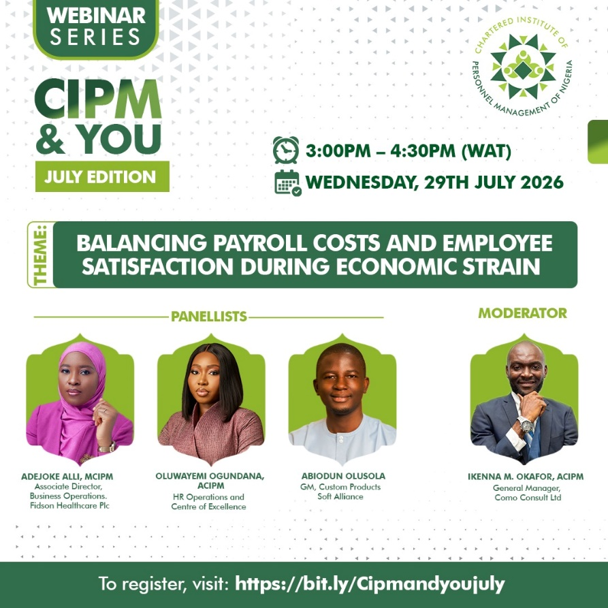
Overview
A company’s payroll is written in numbers, but its legacy is written in people. Behind every salary is a person, a family, a dream and an aspiration. The challenge for organisations, particularly during economic uncertainty, is to maintain business sustainability without compromising the wellbeing of the people who drive performance. Rising operational costs and inflation require difficult decisions, but employees should not be viewed merely as costs to be reduced. They are investments whose engagement, competence and commitment influence organisational performance. While financial losses can be recovered, rebuilding broken employee trust takes time and intentional leadership. HR must therefore move beyond payroll management to strategic workforce value creation, recognising that employee wellbeing and business profitability are complementary. The objective is to control costs responsibly while creating an environment where employees feel valued, motivated and equipped to contribute to sustainable growth.
Managing Personnel Costs Without Undermining Employee Value
Organisations must look beyond payroll expenses to understand their overall personnel costs. While payroll covers salaries, wages and overtime, personnel costs also include medical expenses, shared services, canteen services, official vehicles and associated depreciation. Monitoring personnel cost-to-revenue ratios provides a broader perspective on workforce expenditure. Indicatively, manufacturing organisations may operate within a 10%–15% range, while service-based and IT organisations may record 30%–50%, reflecting their greater dependence on human resources. These benchmarks should, however, be assessed against industry realities and organisational circumstances. HR should work with the CFO and other business leaders to identify opportunities for responsible cost optimisation. Options include recruitment freezes, reviewing salary increases, managing overtime expenditure and replacing expensive official vehicle purchases with more cost-effective allowances. For example, one organisation addressed rising overtime costs through town hall meetings, internal communication and reduced overtime budgets. Supervisors were encouraged to allocate work more efficiently and complete tasks within approved working hours. This helped control expenditure, improve productivity and promote work-life balance. The central consideration is not simply how much an organisation spends on employees, but whether its workforce expenditure delivers sustainable business value.
Leadership, Communication and Fair Reward Practices
When salary increments or compensation reviews are delayed, leadership communication becomes particularly important. Employees should receive timely and honest information about organisational challenges, proposed interventions and their potential implications. Early communication allows employees to plan their personal and family commitments and builds a sense of shared responsibility. Employee retention also depends on opportunities for career progression and recognition. Employees should understand their potential career paths, the positions they could occupy within the next two to three years and, where applicable, their readiness for succession opportunities. A documented reward and recognition framework is equally essential. Employees who make significant contributions should understand how their efforts translate into organisational recognition. For instance, an employee who generates ₦1 billion in revenue should have clarity on how that contribution is acknowledged and rewarded. Where employees perceive that organisational gains benefit only senior management, motivation and commitment may decline. Organisations must also balance general salary adjustments with targeted rewards for high performers and employees in strategically critical roles. A practical approach combines modest cost-of-living adjustments, such as transport allowances, where financially feasible, with transparent, performance-based rewards for critical talent. Clear eligibility criteria are essential to prevent perceptions of favouritism and protect workforce trust.
Improving Employee Experience Beyond Salary Adjustments
Employee experience begins at recruitment and continues through onboarding, career development and eventual exit. It should not be addressed only when engagement scores decline or employees begin resigning.
Exit and stay interviews frequently reveal that employees leave for reasons beyond remuneration, including poor relationships with line managers, organisational culture and limited workplace flexibility. Organisations can therefore improve satisfaction through practical initiatives that do not necessarily require substantial financial investment.
These include:
- Flexible work arrangements: Introduce flexible hours or hybrid work where operationally feasible, considering employees’ different circumstances, including family responsibilities and the challenges of commuting in cities such as Lagos.
- Transportation support: Explore partnerships with transportation providers as an alternative to the significant costs of purchasing and maintaining staff buses.
- Non-monetary benefits: Consider subsidised meals, shopping discounts and partnerships with service providers to reduce employees’ everyday expenses.
- Respectful employee interactions: Demonstrate consideration throughout the employee journey, including prompt communication when interviews are rescheduled and a welcoming onboarding experience.
Learning and development should also remain a priority. It is a strong non-financial driver of employee satisfaction because it demonstrates that the organisation is invested in employees’ future, not just their immediate contributions. Development opportunities strengthen career progression, competence and confidence while communicating recognition and appreciation. Even seemingly minor workplace benefits and tools can influence retention decisions, reinforcing the importance of understanding what employees genuinely value.
Using Employee Feedback, Data and Technology to Inform Decisions
Effective compensation decisions should be based on evidence rather than assumptions. Employee opinion surveys, pulse surveys, stay interviews and exit interviews help HR understand what employees value, whether salaries are competitive and how they perceive existing benefits, including health maintenance organisation (HMO) services. One organisation, following the removal of the fuel subsidy, received feedback that employees were struggling with increased transportation and living costs. HR prepared a report comparing previous and current costs of transportation, rent and food against employees’ earnings. The evidence demonstrated the extent to which inflation had eroded purchasing power and supported management’s decision to undertake a salary review. This illustrates the importance of translating employee feedback into credible business insights. Technology and workforce analytics can further strengthen this process. HR should monitor employee turnover and retention, exit interview trends, engagement scores, payroll complaints, productivity and time-to-fill for critical positions. These indicators help identify whether compensation decisions are achieving their intended outcomes or creating unintended retention risks.
HR must also influence board-level decisions through predictive and prescriptive analytics, not merely historical reports. Recommendations should demonstrate how workforce decisions affect profitability, shareholder value, productivity and employer reputation. Understanding board priorities and connecting HR proposals to these priorities strengthens HR’s strategic influence.
Building Trust Through Organisational Culture and Accountable Leadership
Organisational culture is reflected in what leaders do, not merely what they say. Employees are unlikely to embrace cost-reduction measures when management communicates financial constraints but continues unnecessary spending, expensive purchases or avoidable international trips.
Trust also requires consistency in implementing organisational policies, including promotion and reward processes. Where salary reductions become unavoidable, leadership should demonstrate shared sacrifice, with senior management accepting proportionately greater responsibility rather than transferring the burden to junior employees. During the COVID-19 pandemic, one organisation facing financial uncertainty introduced temporary salary reductions instead of redundancies. Senior management salaries were reduced by 50%, middle management by 30% and junior employees by 20%. The arrangement was transparently communicated, agreed upon and linked to a commitment to refund the withheld amounts if the organisation achieved its year-end financial targets. Having exceeded its targets, the organisation subsequently refunded the withheld salaries. The example demonstrates how transparency, accountable leadership and shared responsibility can protect jobs, strengthen trust and encourage employees to support organisational recovery.
Protecting Employee Welfare and Business Sustainability in SMEs
Small and medium-sized enterprises must first establish their actual financial position before making compensation decisions. Management should review at least six months of financial reports to understand revenue trends, operational pressures and the organisation’s ability to meet monthly salary obligations. Where financial constraints persist, alternative compensation arrangements may be considered, provided they are transparent, mutually understood and legally compliant. For example, an employee earning ₦1 million monthly could receive a guaranteed 60% salary of ₦600,000, with the remaining ₦400,000 linked to agreed performance and revenue targets over a defined period. For a salesperson, this could mean earning the full salary upon achieving the agreed sales targets. Such arrangements may support business recovery while providing employees with a predictable minimum income. HR must, however, ensure that the terms are clearly communicated, fair and consistent with applicable employment obligations.