The Chartered Institute of Personnel Management of Nigeria (CIPM), Nigeria’s only statutory regulatory body for the practice of human resource management, has inducted 78 new members into the HR profession during its 71st Induction Ceremony.
The virtual ceremony underscored the Institute’s commitment to innovation, professional excellence, and responsiveness to the evolving world of work, while reaffirming its statutory mandate to regulate and promote human resource management practice in Nigeria.
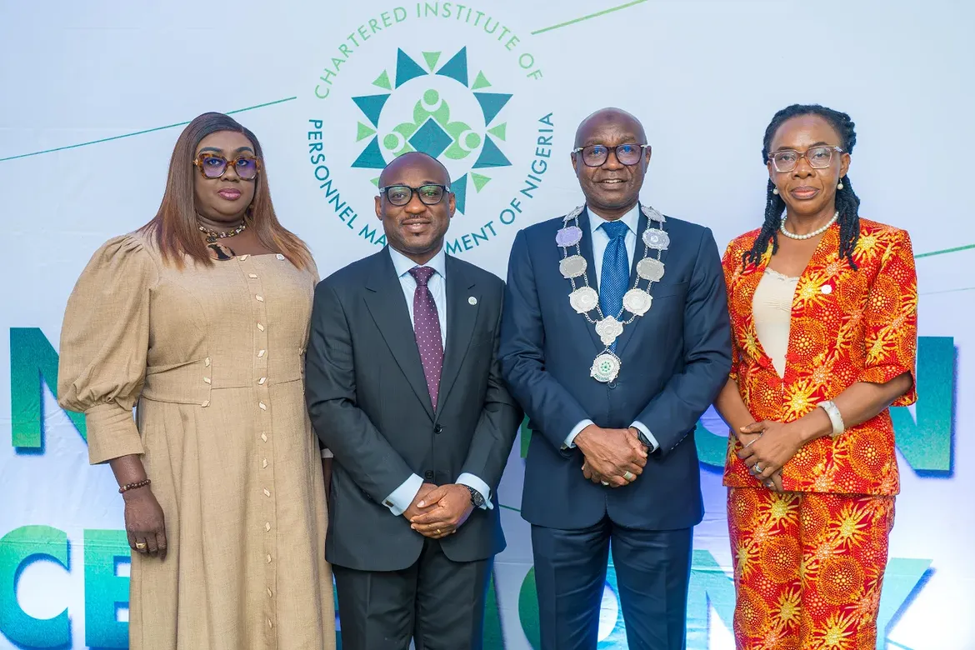
L-R: Registrar/Chief Executive of CIPM, Ms. Oluwatoyin Naiwo, FCIPM, Chartered FCIPD; National Treasurer of CIPM, Mr. Adeyemi Ajayi, FCIPM, Chartered FCIPD; President and Chairman of the Governing Council of CIPM, Mallam Ahmed Ladan Gobir, FCIPM, fnli; Vice President of CIPM, Mrs. Chidinma Justina Obiejesi, FCIPM, at the 71st Induction Ceremony of CIPM, held recently in Lagos, Nigeria.
Speaking at the ceremony, the President and Chairman of the Governing Council of CIPM, Mallam Ahmed Ladan Gobir, FCIPM, fnli, congratulated the newly inducted members and emphasised the Institute’s commitment to innovation and responsiveness in delivering value to its members.
According to him, the decision to hold the induction virtually demonstrated the Institute’s commitment to practising the principles it advocates.
“As HR professionals, we constantly advise organisations to be agile, innovative, and responsive to changing realities. At CIPM, we practise what we preach. There was no need to keep HR professionals waiting, so we chose innovation over tradition,” he stated.
Describing the inductees as “78 success stories,” the CIPM President said their admission into the Institute signified a commitment to professionalism, ethical conduct, and continuous learning.
“You are receiving much more than a certificate. You are receiving professional recognition, credibility, a badge of trust, and greater responsibility. Every time you append ACIPM, MCIPM, or FCIPM to your name, you are making a statement that you belong to a profession,” he noted.
Mallam Gobir urged the newly inducted professionals to wear their CIPM membership with pride and integrity while actively participating in the activities of the Institute at branch, chapter, and national levels.
Delivering the keynote presentation, the Guest Speaker, Reverend Dr. Collins Edebiri, FCIPM, challenged HR professionals to move beyond traditional administrative roles and become strategic drivers of organisational success.
Speaking on the theme, Raising the Bar of Professional Standards: HR as a Steward of Transformation, he noted that the HR profession has evolved into a strategic business function responsible for shaping organisational culture, building capability, driving employee engagement, and enabling sustainable business performance.
According to him, modern HR professionals must demonstrate strategic thinking, emotional intelligence, data-driven decision-making, coaching capability, innovation, and sound ethical judgement to remain relevant in an increasingly dynamic business environment.
Dr. Edebiri further emphasised that HR professionals are no longer merely custodians of policies but architects of organisational success whose responsibilities extend to talent development, culture building, organisational change, leadership development, and workforce planning.
In her closing remarks, the Vice President of CIPM, Mrs. Chidinma Justina Obiejesi, FCIPM, reminded the newly inducted members that they were joining the HR profession at a defining moment when their strategic contributions are more critical than ever. She urged the new members to continually raise the bar of professional standards, uphold the values of the Institute, and serve as stewards of transformation in their respective organisations.
The 71st Induction Ceremony reaffirmed CIPM’s commitment to innovation, professionalism, and excellence in the practice of human resource management. It also underscored the Institute’s resolve to leverage technology while equipping HR professionals with the competencies required to lead people and organisations successfully in an increasingly digital and rapidly evolving world of work.