
Overview
Employee disengagement is a significant but often overlooked workplace challenge. Employees may continue attending work, meeting deadlines and responding to emails while gradually losing enthusiasm, initiative and trust. This decline often manifests in reduced commitment, fewer ideas and a reluctance to go beyond minimum expectations. Employee engagement goes beyond workplace activities, motivational messages and annual social events. It is about creating an environment where employees feel safe to speak, trusted to contribute, equipped to perform and valued for their efforts. Strategies, policies and technology can only deliver meaningful results when employees understand their purpose and believe their contributions matter. Trust is built through consistent actions, while learning and development demonstrate an organisation’s willingness to invest in its people. As roles, technology and business expectations evolve, continuous learning equips employees with the capabilities required to remain effective. Ultimately, trust creates the foundation for engagement, learning strengthens capability, and engagement drives productivity.
Understanding Employee Engagement, Trust and Productivity
Engaged employees do more than complete assigned tasks; they demonstrate commitment, initiative and discretionary effort. Achieving this requires organisations to understand what motivates employees and creates a meaningful connection between individual aspirations and organisational objectives. Employees value development opportunities that support both business priorities and personal growth. Training is more effective when it’s relevance to career progression, expanded responsibilities and organisational performance is clearly communicated. Similarly, meaningful work, opportunities to contribute and alignment with broader societal goals can strengthen employees’ sense of purpose. The relationship between employers and employees should be viewed as a partnership. Employees are recruited to fulfil specific organisational needs, but they must also be given the opportunity, resources and support to deliver on those expectations. Where the reality of employment differs significantly from what was promised during recruitment, trust can quickly deteriorate. Engagement is therefore not simply about keeping employees entertained or organising team-building activities. It is about how people participate in the organisation, understand its direction and feel empowered to contribute to its success. Organisational policies and stated values must also be reflected in everyday behaviour. Promises made to employees should be honoured, and trust must be demonstrated through action rather than words.
Leadership Behaviours That Build or Erode Trust
Leadership has a significant influence on employee engagement. Trust is weakened when leaders lack transparency, fail to honour commitments or behave inconsistently with the values they communicate. Although isolated positive actions may create a favourable impression, trust develops when leaders consistently demonstrate integrity, transparency, reliability and a willingness to listen. Globally, employee engagement stands at 20%, compared with 17% in Nigeria, highlighting the scale of the challenge. When employees repeatedly experience broken promises or feel undervalued, some may withdraw discretionary effort, engage in ‘quiet quitting’ or redirect their attention towards personal interests. Organisations must recognise that employee commitment is influenced by how they are treated and whether their contributions are valued. Performance improvement plans, for instance, should be developmental rather than primarily punitive. When employees fail to meet expectations, managers should establish the underlying causes and provide appropriate support instead of immediately resorting to threats of dismissal. Employees also need reasonable autonomy to experiment, make mistakes, learn and improve. A high-trust environment encourages accountability while giving people the confidence to contribute ideas and take responsibility for results.
Designing Structured Learning for Better Engagement and Performance
Training is sometimes treated as an employee reward or an annual activity to satisfy organisational targets. However, learning and development should be approached as a strategic business investment. A useful measure of its effectiveness is whether responsibility for training outcomes rests solely with HR or is shared with the business. Every training intervention should have clearly defined objectives, an accountable business owner and measurable indicators of success. These may include improved performance, behavioural changes, increased productivity or readiness for more demanding responsibilities. Employees should also understand why they have been selected for training and how the learning relates to organisational priorities. Line managers have an important role in communicating these expectations before a programme begins, ensuring that participants understand the gaps being addressed and the outcomes expected. Organisations should consider establishing structured learning academies supported by proper needs assessments and pre-training discussions. These help identify capability gaps, clarify learning expectations and ensure that interventions are relevant. Importantly, not every performance or behavioural challenge requires training. Some issues may be better addressed through coaching, constructive conversations or improved management support. Organisations must distinguish between a skills gap, a readiness gap and an unwillingness to improve before deciding on the appropriate intervention. Training opportunities should also be allocated based on genuine development needs rather than workplace politics or personal relationships. Performance appraisals can provide a useful basis for identifying individual gaps, developing targeted learning plans and evaluating progress during subsequent appraisal cycles. The objective is to ensure that the right employees receive the right interventions for the right reasons.
Measuring Learning Effectiveness and Closing the HR–Business Gap
The success of learning initiatives should be measured by their impact rather than the number of programmes delivered or employees trained. Organisations must establish what a training intervention is expected to change and assess whether those changes have occurred. This requires shared accountability between HR, business leaders and line managers. HR should provide the learning framework, identify appropriate interventions and monitor outcomes, while business leaders must take ownership of the performance improvements expected from their teams. Employees also need to experience consistency between organisational promises and actual workplace practices. Where HR identifies concerns about leadership behaviour or unfulfilled commitments, it should engage senior management, communicate the potential consequences and advocate for appropriate action. HR professionals must be prepared to maintain their position professionally and constructively, even when challenging difficult decisions. Genuine engagement requires leaders to listen to employees, take their concerns seriously and seek expert advice where necessary. Organisations do not always need expensive initiatives to demonstrate care; consistency, recognition, communication and genuine involvement can make a considerable difference.
Building Genuine Engagement Beyond Perks and Benefits
The popular observation that employees leave managers rather than organisations highlights the importance of effective line management. While remuneration and benefits remain important, they are not the only factors influencing employee commitment. In one organisational survey, employees ranked salary and benefits fifth among the things they valued most, while simple recognition emerged as the highest priority. This illustrates that employees often place considerable value on being appreciated and acknowledged for their contributions.
Organisations should therefore invest in developing managers who can lead, mentor, coach and support their teams effectively. Managers must understand their responsibility for creating an environment where employees feel involved, respected and motivated. Without effective management, additional perks and benefits may have limited impact.
Middle managers are particularly important because they serve as the link between senior leadership and employees. Often interacting with employees more frequently than other management levels, they understand workplace realities and can communicate concerns that may not always be expressed openly. Senior leaders should equip them with the right leadership capabilities, listen to their feedback and recognise their contribution to organisational performance. Transparency and communication are equally essential. Although confidential information must remain protected, unnecessary secrecy can undermine trust, particularly when employees obtain organisational information from external sources. Organisations should create appropriate opportunities for employees to understand business priorities, participate in decisions and feel connected to the organisation’s direction. Flexible working arrangements, meaningful involvement and consistent communication can further strengthen this connection, particularly in an increasingly competitive talent environment.
Conclusion
Genuine employee engagement cannot be achieved through perks, benefits or training programmes alone. It is built on trust, meaningful work, effective leadership, consistent communication and a genuine commitment to employee development. Organisations must align learning investments with business objectives, identify actual development needs, measure outcomes and hold leaders accountable for their commitments. Equally, managers must be equipped to recognise, support and involve employees in achieving organisational goals. When employees feel valued, trusted, informed and supported, they are more likely to contribute meaningfully, take ownership of results and remain committed to organisational success. Building this environment is not simply an HR responsibility; it is a shared leadership responsibility and a critical investment in sustainable organisational productivity and growth.
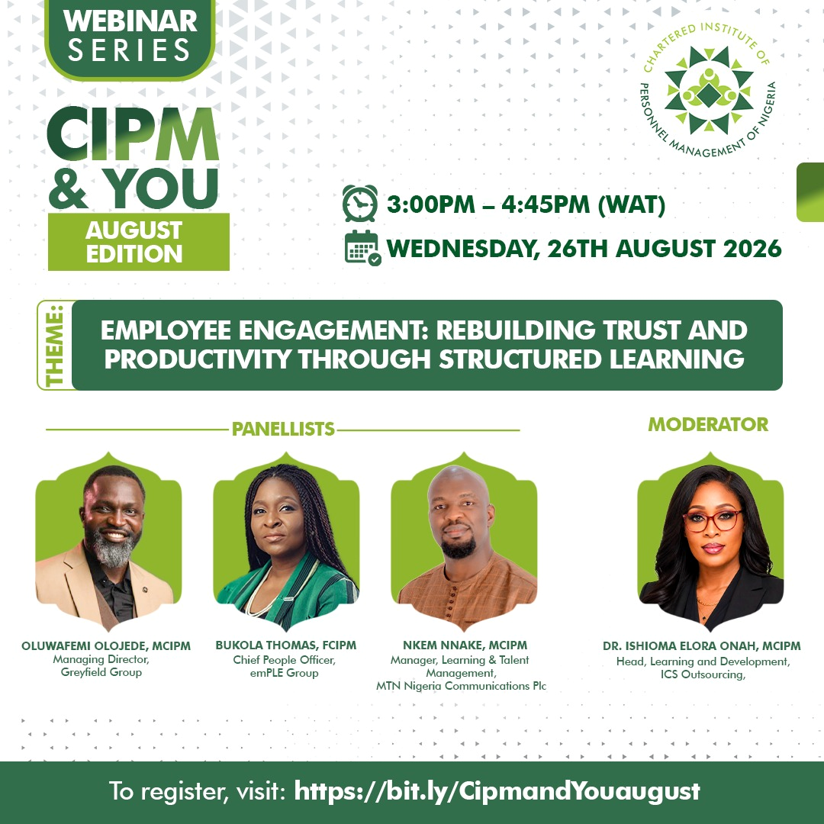
This thought leadership piece was adapted from the August 2026 edition of the ‘CIPM and YOU’ webinar and represents the opinions of the panellists during the session.