Lagos State Governor, Mr. Babajide Sanwo-Olu, MCIPM, has underscored the critical role of Human Resource professionals in preparing Nigeria for the future of work, describing the Chartered Institute of Personnel Management of Nigeria (CIPM) as a strategic partner in the development of the human capital needed to drive economic growth in the age of Artificial Intelligence (AI).
The governor, who spoke at the Special Human Resource Forum (SHRF) 2026 organised by CIPM, revealed that one of the pillars of Lagos State’s long-term development strategy is to position the state as a leading centre for human capital development globally, adding that this vision aligns closely with CIPM’s mission of advancing people management excellence and professional development.
“There is no way we can achieve that without a real partnership with institutes like CIPM. Your vision and our vision as a state are truly aligned,” he added.
Sanwo-Olu noted that HR professionals can no longer afford to remain on the sidelines as technological disruption continues to reshape workplaces, industries and economies. According to him, the future of work requires organisations to anticipate emerging skills and prepare their workforce accordingly.
“HR personnel cannot take the back seat. You really need to know what skills your staff require and where the future of work is going,” the governor said.
The governor further commended the Institute for its growing impact on workforce development in Nigeria, noting that many Lagos State civil servants have benefitted from CIPM’s professional development programmes and certifications.
“I have seen the consistent level of competencies that the Institute has developed in the system, and particularly how it has helped us in the public sector space. I am truly proud of the growth I have seen over the last decade. I am one of your quiet cheerleaders. I will do everything to ensure that the Institute takes its rightful place among other professional institutes in the country,” he said.
In his remarks, the President and Chairman of the Governing Council of CIPM, Mallam Ahmed Ladan Gobir, FCIPM, fnli, challenged HR professionals to take the lead in ensuring that artificial intelligence becomes a tool for inclusive growth rather than a driver of inequality.
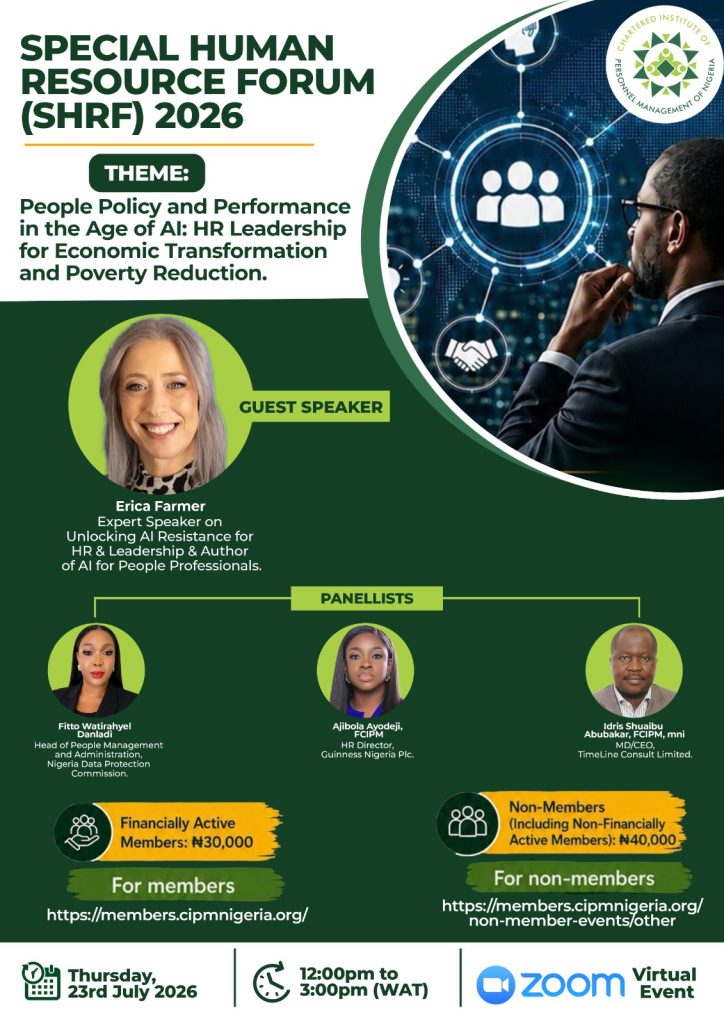
Speaking on the theme, ‘People Policy and Performance in the Age of AI: HR Leadership for Economic Transformation and Poverty Reduction,’ Mallam Gobir said the future impact of artificial intelligence would depend less on technology and more on the quality of leadership and people-focused policies guiding its adoption.
“History will not remember us for how quickly we adopted artificial intelligence. History will remember us for whether artificial intelligence improved the lives of our people, whether it created jobs or displaced livelihoods, and whether it reduced poverty or widened inequality,” he said.
Delivering the keynote presentation, global AI and leadership expert Erica Farmer urged organisations to put people at the centre of their AI strategies, warning that technology alone will not guarantee economic growth or social progress.
Farmer described AI as “mass intelligence” rather than conventional technology and noted that its transformative potential depends largely on how organisations deploy it and how leaders prepare their people for change
While citing projections that AI could contribute as much as $1 trillion to Africa’s GDP by 2035, she noted that such gains would only be realised through intentional investments in skills, leadership and workforce adaptation.
“Potential doesn’t automatically equal prosperity. We need to take people on that journey, and this is the defining moment for HR,” she said.
Farmer maintained that HR leaders must play a central role in shaping organisational responses to AI, describing them as the professionals best positioned to guide workforce transformation and help leaders make better decisions.
Participants agreed that as artificial intelligence continues to reshape the world of work, investments in human capital, leadership capability and workforce readiness will remain critical to national development and long-term economic competitiveness.