Overview
Organisational stagnation rarely happens overnight. It develops gradually through delayed decisions, ignored trends, outdated processes and missed opportunities. Eventually, competitors advance, talented employees leave and customers seek better alternatives. In today’s business environment, sustained relevance requires continuous improvement in leadership, innovation, people management and organisational thinking. Human Resources (HR) must therefore move beyond administrative responsibilities to become a strategic driver of organisational growth. The critical questions are: What needs to change? What can be improved? What are the organisation’s blind spots? Are we preparing for the future or simply maintaining the status quo? Effective HR leaders anticipate disruption rather than wait for it. Organisations that remain competitive are those willing to learn, unlearn and adapt. Ultimately, activity should never be mistaken for progress, and past success should never become a substitute for continuous improvement.
Recognising the Early Warning Signs of Organisational Stagnation
Complacency can be likened to a stagnant pool: without movement, it gradually loses its vitality. Similarly, organisations that become too comfortable with existing practices risk losing their competitiveness.
Some early warning signs include:
- Declining employee engagement: Reduced enthusiasm, absenteeism, lateness and declining commitment may indicate that employees are becoming disconnected from organisational goals.
- Loss of top talent: High performers may leave not only for better remuneration but also because of limited career progression, inadequate development opportunities and an uninspiring work environment.
- Increasing customer complaints: Deteriorating service standards and failure to respond to changing customer expectations can weaken loyalty and drive customers towards competitors.
- Leadership-employee disconnect: When organisational values and leadership commitments are not reflected in everyday practices, employee trust and confidence gradually decline.
These indicators should prompt HR and leadership to investigate underlying issues before they develop into more serious organisational challenges.
Why Successful Organisations Sometimes Resist Change
Past success can create a false sense of security. Organisations that have performed well for years may become resistant to change because they assume existing strategies will continue to deliver results.
Five common factors contribute to this mindset:
- Overreliance on past successes: Continuing to depend on previously successful strategies without assessing their relevance to changing business realities can undermine future competitiveness.
- Overvaluing organisational legacy: Preserving traditions simply because “this is how we have always done it” discourages fresh thinking and prevents necessary transformation.
- Overvaluing established processes: Familiar procedures may become inefficient over time. Without regular reviews, organisations risk maintaining outdated processes that restrict productivity and innovation.
- Restricting talent mobility: Managers who refuse to release high-performing employees for internal opportunities may unintentionally limit their development and increase the likelihood of losing them. Succession planning, career progression and internal mobility are essential to retaining talent and sustaining business continuity.
- Mistaking stability for strength: Stability should not encourage complacency. Instead, it should provide an opportunity to assess risks, anticipate future challenges and protect the organisation against unexpected changes.
How Complacency Affects Employee and Leadership Behaviour
Complacency gradually becomes embedded in organisational culture through everyday attitudes and behaviours. Among employees, it may manifest through withdrawal of initiative, resistance to change, declining interest in learning, reduced discretionary effort, low morale and a fixed mindset that discourages questioning established practices. Among leaders, it often appears through excessive celebration of past achievements, limited future-oriented thinking and the dismissal of emerging warning signs. When employees stop contributing ideas and leaders stop questioning existing practices, the organisation loses its capacity to evolve. HR must therefore pay attention not only to performance outcomes but also to the behaviours and mindsets driving them.
HR’s Strategic Role in Preventing Organisational Stagnation
The cost of complacency is often greater than the cost of change. HR is uniquely positioned to identify emerging organisational risks, assess workforce capabilities and recommend interventions. However, preventing stagnation cannot be HR’s responsibility alone. CEOs, executive management, business leaders and employees must share ownership of organisational growth.
HR must operate as a strategic business partner by:
- Identifying early signs of disengagement and cultural decline through regular employee engagement and workforce assessments.
- Assessing existing and future workforce capabilities against emerging business requirements.
- Promoting continuous learning, talent development, succession planning and internal mobility.
- Advising management on organisational risks and ensuring recommendations translate into practical interventions.
Ultimately, HR can identify the risks and recommend solutions, but sustainable progress requires leadership commitment and collective accountability.
Building a Culture of Curiosity, Learning and Constructive Challenge
Organisations that stop learning eventually lose their capacity to compete. Curiosity, knowledge-sharing and continuous development are essential to remaining relevant.
HR can promote these behaviours by:
- Integrating learning into performance management: Make development part of performance expectations through sponsored training, professional qualifications, further education and independent learning. Employees should have opportunities to apply acquired knowledge to workplace challenges.
- Normalising questions and feedback: Encourage open conversations, constructive criticism and differing perspectives through town halls, departmental meetings and leadership engagement. Questions such as “What are we missing?” and “What can we improve?” should be welcomed.
- Encouraging cross-functional exposure: Provide opportunities for employees to experience different roles and functions. This broadens capabilities, strengthens adaptability and prevents career stagnation.
- Promoting knowledge-sharing: Break down information silos and make existing organisational knowledge accessible. Encourage collaboration and the reuse of available information rather than repeatedly recreating what already exists.
Leadership: Reinforcing or Challenging Complacency
Leadership behaviour significantly influences organisational culture, performance and the willingness to embrace change. Complacency is reinforced when leaders glorify past achievements, discourage dissenting opinions, become disconnected from frontline realities or tolerate mediocre performance because of personal relationships and organisational influence. To counter these tendencies, leaders must encourage continuous improvement, remain connected to employees and customers, welcome constructive feedback and hold themselves accountable for results. Accountability must apply consistently, regardless of position or relationship. Leaders must also demonstrate the behaviours they expect from employees. An organisation cannot build a culture of innovation when its leadership resists questioning or refuses to acknowledge the need for change.
Creating Psychological Safety to Challenge the Status Quo
Psychological safety enables employees to express opinions, raise concerns and challenge existing practices without fear of humiliation or retaliation. It creates the conditions for curiosity, innovation and constructive disagreement.
HR has an important responsibility to establish this environment by:
- Strengthening leadership behaviour: Encourage active listening, respectful engagement and consistency between leaders’ words and actions.
- Including psychological safety in leadership assessments: Evaluate leaders on their ability to create supportive environments where employees feel confident speaking up.
- Establishing trusted feedback channels: Provide reliable opportunities for employees to share concerns through surveys, discussions and other feedback mechanisms. More importantly, management must respond visibly and act on legitimate concerns.
Psychological safety is not simply about allowing employees to speak; it is about ensuring that speaking up can lead to meaningful consideration and improvement.
Measuring Organisational Agility and Readiness for the Future
HR should monitor indicators that reveal whether the organisation is progressing or becoming stagnant. Important measures include:
- Speed of decision-making: How quickly does the organisation respond to emerging challenges and opportunities?
- Implementation of strategic initiatives: How effectively and promptly are decisions from strategic retreats and planning sessions translated into action?
- Rate of change adoption: How readily do employees embrace new processes, technologies and ways of working?
- Succession readiness: How many employees are adequately prepared to assume higher responsibilities and succeed their current leaders?
These indicators provide insight into organisational responsiveness, execution, adaptability and workforce preparedness.
Lessons from Organisations That Failed to Adapt
The experiences of Kodak and Nigeria’s NITEL illustrate the consequences of complacency.
Kodak dominated the photography industry for decades and even developed a digital camera prototype in 1975. However, concerns about the impact of digital technology on its traditional film business delayed its transition. As competitors embraced digital photography, Kodak lost its competitive advantage. Its experience demonstrates the danger of protecting existing revenue streams at the expense of future relevance. NITEL, once a dominant telecommunications provider in Nigeria, struggled with bureaucracy, operational inefficiencies and poor customer service. The introduction of GSM services in 2001 enabled operators such as MTN, Econet and Globacom to expand access through more accessible technologies and services. NITEL’s decline illustrates the consequences of failing to respond to technological advancement, competition and changing customer expectations. Both examples reinforce an important lesson: previous market leadership does not guarantee future relevance.
Conclusion
Organisational complacency develops gradually but carries significant consequences for employee engagement, innovation, competitiveness and long-term sustainability. HR must take a proactive strategic role in identifying warning signs, developing talent, strengthening organisational culture and preparing the workforce for future demands. However, lasting progress requires collaboration, accountability and commitment from leadership and every organisational stakeholder. Organisations must continually question established practices, invest in learning, embrace constructive challenge and remain responsive to change. Ultimately, the difference between sustained success and organisational stagnation lies in the willingness to evolve rather than depend on past achievements.
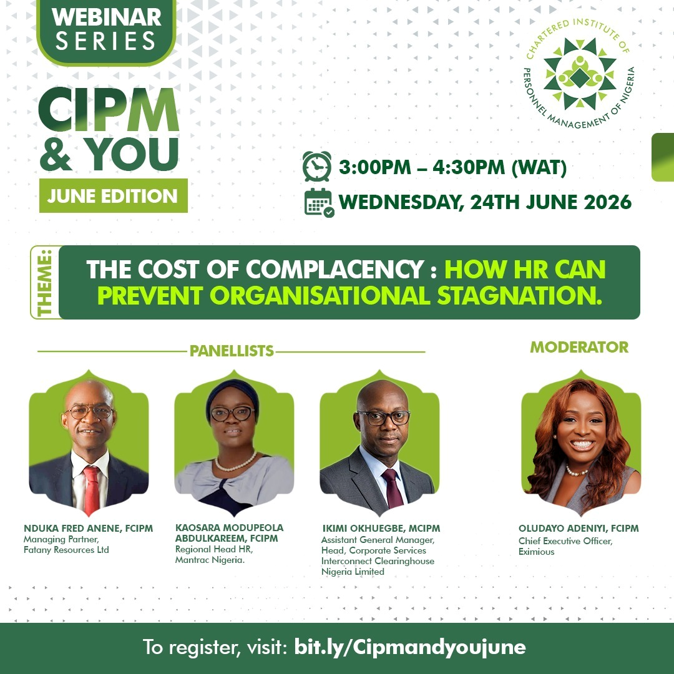
This thought-leadership article was adapted from the June 2026 edition of the CIPM and YOU webinar and represents the opinions of the panelists during the session.